
Sujoy Dhar | @justearthnews | 16 May 2026, 05:38 am Print
 Energy Security
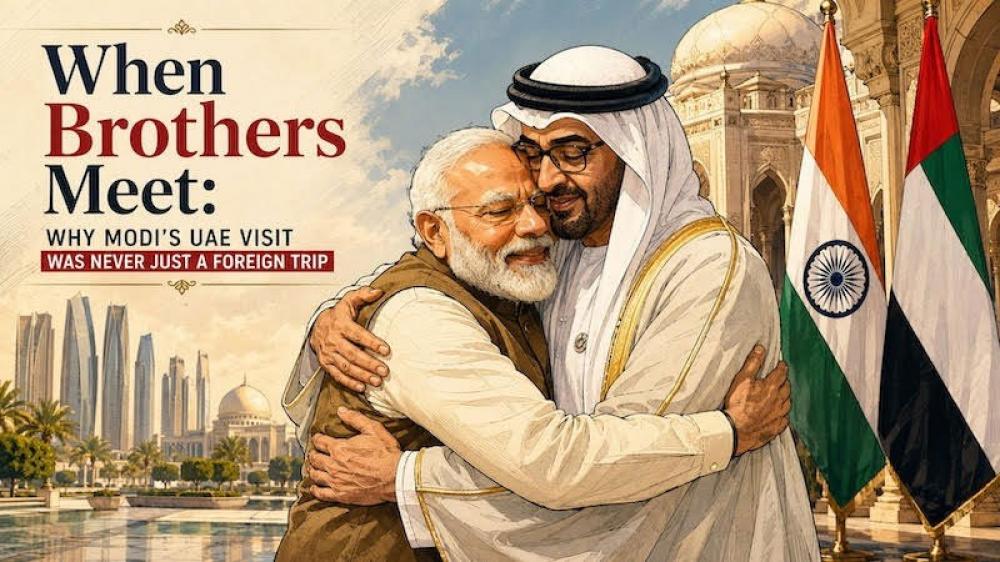
 Brothers in Diplomacy, Partners in Power. Photo: AI-generated
The critics were quick off the mark. Barely a week after Prime Minister Narendra Modi stood before a gathering in Secunderabad and asked Indians to drive less, buy less gold, postpone weddings abroad, and work from home — a call to austerity framed as "economic patriotism" — he boarded Air India One for a five-nation tour. The irony was too tempting for the opposition to pass up.
But geopolitics, unlike social media handles, does not pause for irony.
Modi's austerity appeal came amid surging oil prices as geopolitical tensions in West Asia pushed up India's import bill and strained global supply chains.
India's crude purchases had ballooned from an average of $70.99 per barrel in 2025-26 to $114.48 per barrel in April and $105.40 in May. With the rupee under sustained pressure and foreign exchange reserves shrinking, the first stop on that five-nation tour — Abu Dhabi — was not an indulgence. It was the mission itself.
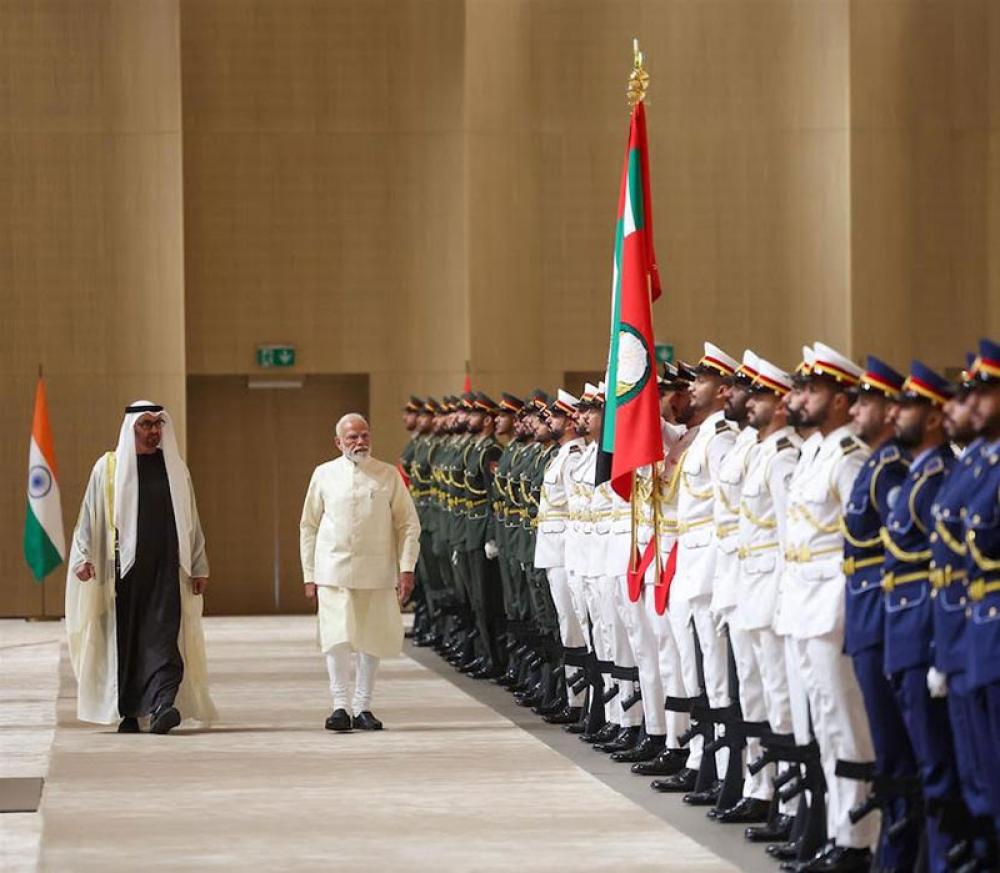 UAE President Sheikh Mohamed bin Zayed Al Nahyan received PM Modi in Abu Dhabi. Photo: PIB
Energy Security: The Barrel That Cannot Wait
This was Modi's eighth visit to the UAE over twelve years — the first in-person engagement between the two leaders since Iran's February 28 missile and drone attacks on the Gulf. The timing was precise, not incidental.
India and the UAE concluded several important energy agreements: enhancing UAE participation in Indian strategic petroleum reserves to 30 million barrels, establishing strategic gas reserves in India, and securing long-term LPG supply agreements between Indian Oil Corporation and Abu Dhabi National Oil Company (ADNOC). For a country where crude imports meet nearly 85 percent of its energy needs, locking in long-term supply from a trusted partner during a regional war is not optics — it is oxygen.
The UAE had already been a pioneer, being perhaps the first and only country to participate in India's strategic petroleum reserves, with over 5 million barrels of crude already stored within India. Friday's agreements expanded that number sixfold, to 30 million barrels — a strategic cushion for a nation acutely aware of how quickly crises can spiral.
Former Indian Ambassador to the UAE Sanjay Sudhir, speaking to DNA India, called the visit "very significant" given the West Asia backdrop, adding that the UAE is India's "anchor energy partner" in the Gulf region — one where the relationship "has moved well beyond a buyer-seller relationship." He noted that LPG fuels 340 million Indian households, and that the UAE is India's second-largest LPG source.
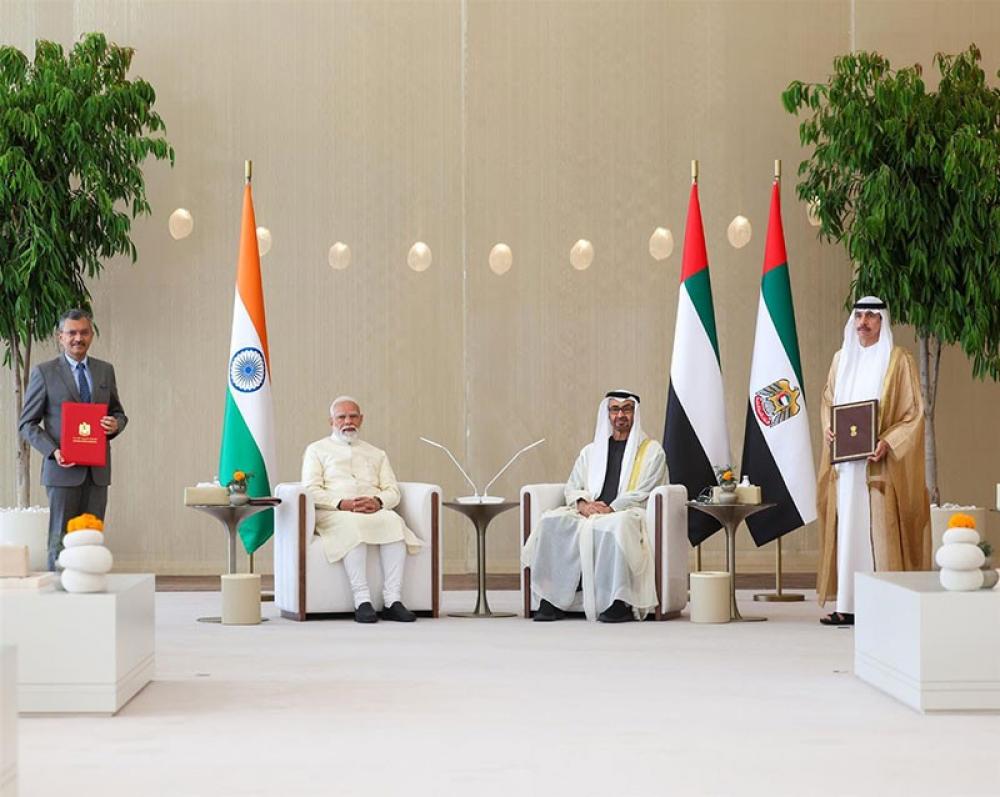 PM Modi and Sheikh Mohamed bin Zayed Al Nahyan witness the Exchange of MoUs between India and the UAE at Abu Dhabi. Photo: PIB
Energy Partnership: The OPEC Exit Changes Everything
The backdrop to this visit carries a seismic shift that the headlines have underplayed. The UAE announced its exit from OPEC after 59 years, with the decision taking effect from May 1, 2026 — driven by Abu Dhabi's ambition to grow oil output from 3.4 million barrels a day to five million by 2027, an ambition incompatible with OPEC's collective quota discipline.
For India, this changes the calculus profoundly. Outside OPEC, ADNOC is now free to pursue long-term bilateral supply contracts with Asian buyers without needing the cartel's approval. The Indian ambassador described the UAE's OPEC exit as opening up "new opportunities," particularly in how the UAE's expanded partnership could help supply gas directly to Indian households.
The era of negotiating through a cartel intermediary is ending. India gets a direct line to a friendly, prolific producer.
For India, where every ten-dollar rise in Brent adds roughly ₹1.33 lakh crore to the annual import bill, having a partner unconstrained by OPEC quotas — and motivated by strategic alignment rather than cartel politics — is a structural advantage.
Dr. Sultan Al Jaber, ADNOC Managing Director and Group CEO, had laid out the philosophy plainly at India Energy Week 2026 in Goa in January: "In an era of constant change, reliable partnerships are the real strategic reserves. Transformation rewards those who move boldly, not those who wait for calm seas."
Speaking at the same forum, he described the UAE-India relationship as one that is "strategic, long-term, agile and flexible — steadfast, dependable, principled and consistent. Partnership that is based on trust and will endure through thick and thin." Those words, spoken in January, found their contractual form in Abu Dhabi on Friday.
Energy Diplomacy: When Brothers Build Pipelines
What makes the India-UAE energy corridor unusual is that it is inseparable from the personal. The Indian Ambassador noted that "every time they connect, they refer to each other as brothers," and that Sheikh Mohammed bin Zayed personally came to the airport to receive Modi and gave him a ceremonial guard of honour. Air India One was escorted by UAE F-16 fighter jets as it entered UAE airspace. This is not protocol. This is a statement.
Modi reaffirmed India's strong condemnation of the attacks on the UAE and its solidarity with the UAE leadership and people. That solidarity has a history: when Iran launched missile and drone attacks in February, Modi was among the first to call and condemn.
India also declared its clear position in favour of safe transit passage and unimpeded navigation through the Strait of Hormuz — vital for regional energy and food security.
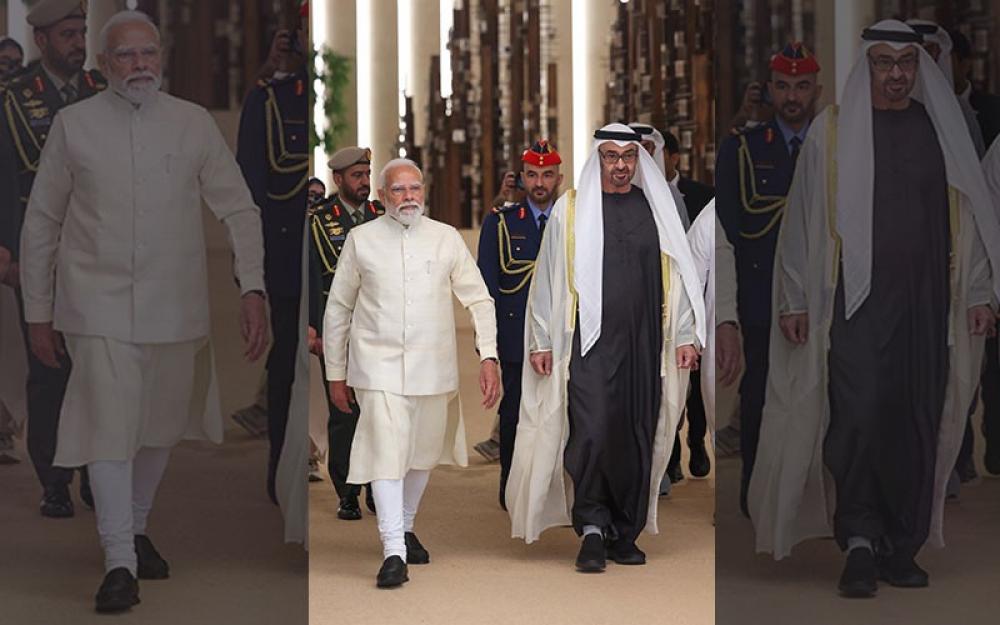 PM Modi and UAE President Sheikh Mohamed bin Zayed Al Nahyan share a very personal bond. Photo: PIB
The UAE's own strategic position matters too. Its growing alignment with the US-Israel axis, its exit from OPEC, and its expanded production plans all point toward an Abu Dhabi that is remaking itself as an independent geopolitical actor — and India, with its 1.4 billion consumers and a massive diaspora on UAE soil, is a natural anchor partner.
The UAE is home to over 4.5 million Indians — the largest Indian diaspora of passport holders anywhere in the world — described by India's ambassador as "Rashtradoots" and a "living bridge" between the two nations.
Their welfare, their remittances, and their goodwill are embedded in every bilateral negotiation. Bilateral trade has already exceeded $100 billion following the Comprehensive Economic Partnership Agreement, and both nations are now targeting $200 billion.
The UAE also announced $5 billion in fresh investments in India, including $3 billion from Emirates NBD into the Indian banking sector — the first investment of this scale from the UAE — and $1 billion from ADIA into priority infrastructure sectors.
Analysts at Discovery Alert, assessing the geopolitical architecture of the Modi visit, noted that "India's capacity to simultaneously host Iran's foreign minister and dispatch its Prime Minister to the UAE — without either visit undermining the other — is a demonstration of what New Delhi's foreign policy establishment calls strategic autonomy: the maintenance of functional relationships across geopolitical fault lines in service of defined national economic interests."
It is precisely this calibrated balancing act — not austerity speeches — that insulates India from the worst of what West Asia's volatility can throw at it.
The opposition's critique — that a PM who asks citizens to curb foreign travel should not himself be travelling — misses the category entirely. In a visit that lasted just two and a half hours, Modi secured 30 million barrels of strategic petroleum reserves, long-term LPG supply lines, a defence partnership framework, and $5 billion in investments.
The two leaders shared a warm hug before Modi boarded the plane for the Netherlands.
That hug is not sentiment. It is strategy. And in an era when West Asia burns and oil markets are being redrawn, India's energy security was quietly and decisively advanced—not from a podium in New Delhi, but from a tarmac in Abu Dhabi.
(Sujoy Dhar is the Group Editor of IBNS and its affiliated platforms.)
- Israel-Lebanon ceasefire extended for 45 days, announces US
- Trump Touches Down in Beijing for high-stakes China visit
- USD1.2 trillion bombshell: The true cost of Trump’s Golden Dome revealed
- Putin unleashes ‘Satan 2’: Russia tests ICBM with 35,000 km range
- Trump shocks with ‘Venezuela as America’s 51st state’ post