
Just Earth News | @justearthnews | 25 Mar 2026, 08:52 am Print
 Iran War
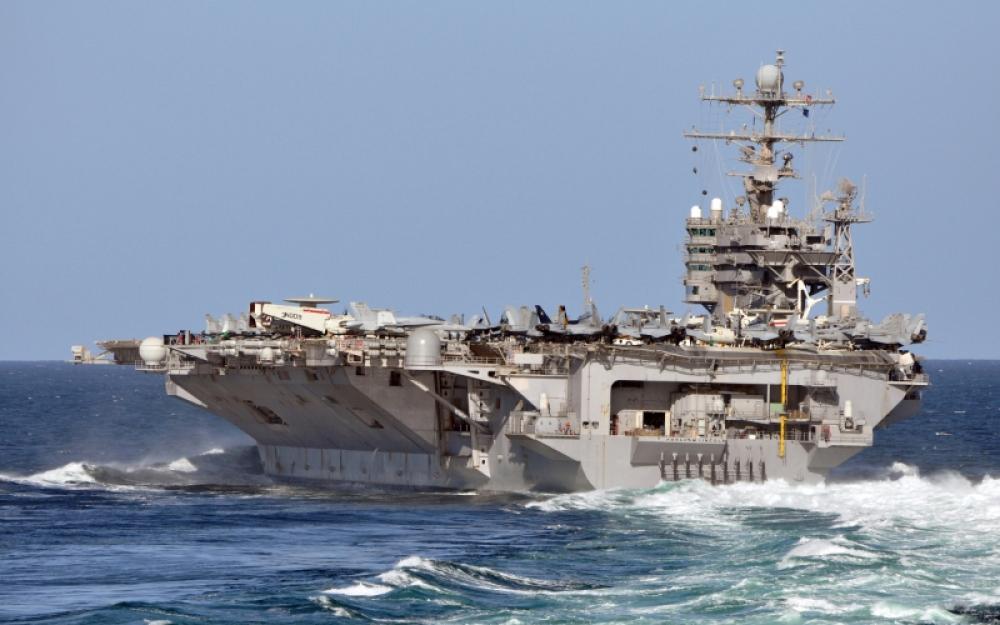
 US Navy aircraft carrier USS Abraham Lincoln. Photo: Wikimedia Commons/U.S. Navy/Capt. Lee Apsley
Iran has claimed that it fired a cruise missile towards the USS Abraham Lincoln shortly after issuing a direct warning to the United States, according to reports from Iranian state television.
However, there has been no immediate confirmation or response from US officials regarding the alleged incident.
Iranian Army public relations stated that coastal cruise missiles were launched in the direction of the aircraft carrier, escalating tensions in an already volatile regional environment.
Warning preceded alleged strike
The development followed a warning from the Iranian Navy, which said the US carrier was under constant surveillance and could be targeted if it moved within range of Iran’s missile systems.
According to Iranian state broadcaster Press TV, Navy Commander Rear Admiral Shahram Irani cautioned that the vessel would be struck if it entered operational range.
? Iran’s Army Navy stated that the USS Abraham Lincoln aircraft carrier was compelled to change position after shore-to-sea cruise missiles were launched. The operation was conducted to assert Iran's maritime sovereignty and counter threats from the hostile fleet. pic.twitter.com/3tG4KYcAHd
— Press TV ? (@PressTV) March 25, 2026
He emphasised that Iranian forces were closely monitoring the carrier’s movements.
Strong rhetoric from Iranian military
Senior Iranian military officials reinforced the warning with sharp statements dismissing US strategic influence.
Lieutenant Colonel Ebrahim Zolfaqari, spokesperson for the Khatam al-Anbiya Central Headquarters, claimed that what was once described as American “strategic power” had now turned into a “strategic defeat”.
His remarks came amid heightened tensions and followed recent developments involving Donald Trump, who had earlier issued a 48-hour ultimatum threatening strikes on Iranian power infrastructure.
Contradictions over diplomatic engagement
The situation has been further complicated by conflicting claims over diplomatic engagement.
Trump recently stated that Washington and Tehran had held “very good and constructive” discussions aimed at resolving hostilities.
However, Iranian officials have denied any such communication.
Press TV cited sources in Tehran asserting that no official talks had taken place between the two sides.
Zolfaqari echoed this stance, declaring that reliance on US assurances was no longer viable.
Escalation follows brief de-escalation signals
The alleged missile launch comes shortly after indications of a temporary de-escalation, when Trump paused potential military strikes following what he described as productive exchanges.
Iran, however, framed the shift differently, suggesting it resulted from its warnings of retaliatory action against regional energy infrastructure.
Regional stability and strategic messaging
Iranian officials maintained that regional stability now depends on their military capabilities.
Zolfaqari described the situation as one of “stability through power”, asserting that there would be no return to previous conditions unless threats of military action against Iran were entirely withdrawn.
He also criticised what he described as internal divisions within the US administration, questioning the coherence of Washington’s approach.
- Surprise move: OpenAI shuts down Sora App
- China’s massive ocean mapping drive sparks global concern over submarine warfare edge
- Middle East crisis: Iran arrested 466 over online activities
- Seven stolen dogs escape meat traders in China, walk 17 km together to return home
- Trump says US postponing military strikes on Iranian power plants amid 'constructive conversations'