
Just Earth News 22 Sep 2016, 01:21 pm Print
Amanda Voisard
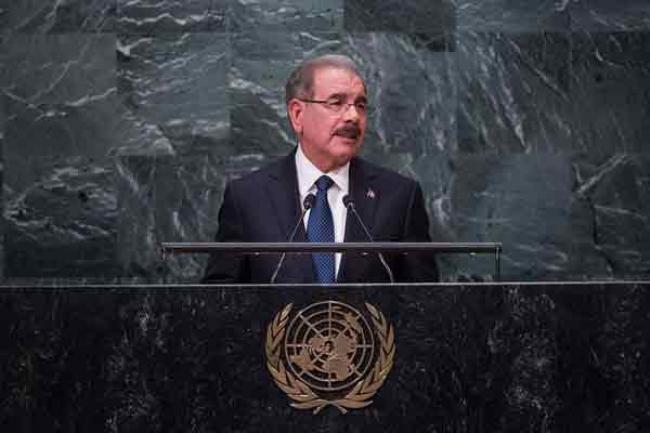
“The challenge we face is to strengthen the position of this emerging class. We must provide them with security and give them the tools and skills to allow them to not only develop their own lives, but also to participate in the development of their countries,” President Danilo Medina told the Assembly’s general debate.
“Let there be no doubt, this new social class itself is a great opportunity for our nations,” he added, explaining that if the potential of this new “emerging middle class” is strengthened, it will be able to demand more complex and better quality products and its path to progress will enable all countries to move forward.
To realize this potential, the President said that social structures related to health, education, employment and security need to be strengthened. He added that this would not only enable them to escape their difficulties, but also create more democratic and peaceful societies with less need for emigration.
Stressing the importance of the 2030 Agenda for Sustainable Development, President Medina said the framework offered a road map to address many of the challenges faced by countries in Latin America, the Caribbean as well as the world.
He added, however, to accomplish the goals laid out in the Agenda, profound changes needed to be made in which trade and financial flows are conducted. “That is, the rules of the game between rich and poor countries must be revised,” he noted, stressing that non-tariff barriers to trade needed to be removed and that global trade had to be made free and fair.
The President also noted the opportunities and threats brought by the financial sector, adding that his country, like many others around the world, can only benefit from more stable, predictable and better regulated financial markets.
Noting that the lack of regulation has made it easy for the evaders to escape taxes and at the same time, made the work of tax administration more complex, he underscored that this is a major threat to state funding worldwide and makes it difficult for governments to fulfil their responsibilities to their citizens, and added that effective “supervision of financial markets [is important] to make these markets serve the real economy and citizenship.”
In conclusion, President Medina underscored that the Dominican Republic is committed to reducing inequalities, both between the richest and poorest within the country as well as helping shape international relations between poor and rich countries.
- UNICEF sounds alarm over Afghanistan’s 25,000-woman teacher and health worker deficit
- Shocking discovery in Bangladesh: Missing Hindu temple custodian found dead under mysterious circumstances
- Pakistan among top 10 nations battling acute food shortage, global report warns
- Who is Meenu Batra? Indian-origin court interpreter detained by ICE after over 35 years in US
- Shocking UN reports: Over 38,000 women and girls killed in Gaza war