Top pick: No need for fast running: Just 10 minutes at walking pace may boost brain function, finds study


Just Earth News | @justearthnews | 28 Mar 2026
#Iran war #Strait of Hormuz crisis #Donald Trump Iran strategy #Israel Iran conflict #global oil prices surge #Middle East war 2026 #US Iran tensions #Hormuz blockade #energy crisis geopolitics #Iran
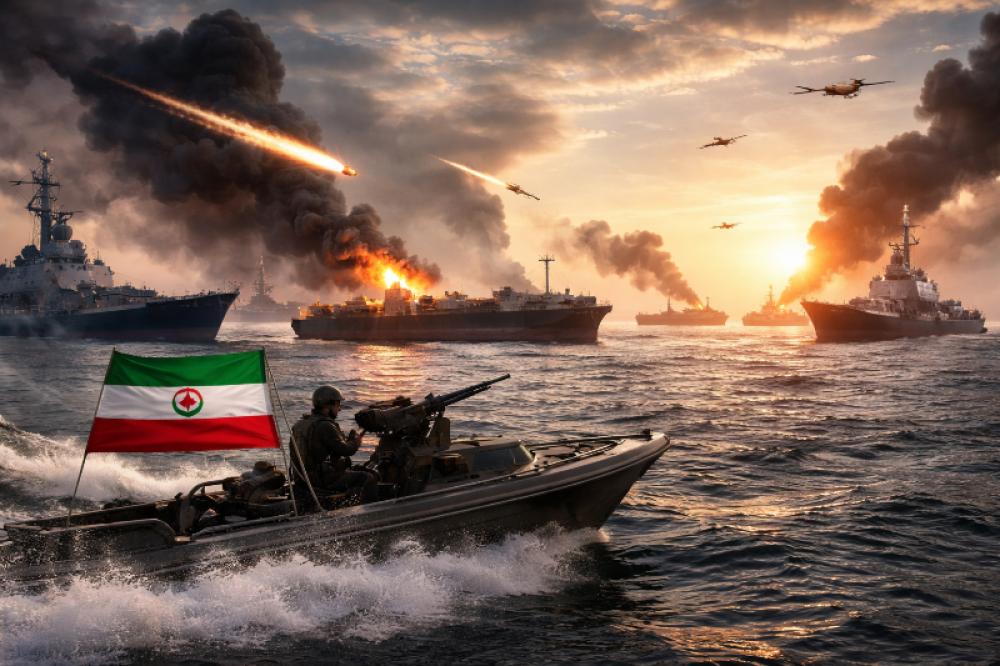
Representational AI image created by ChatGPT
A month after the opening barrage of missiles struck Tehran, the conflict involving Iran has evolved into a complex geopolitical and economic crisis that has extended far beyond initial expectations.
What began as a coordinated military campaign by the United States and Israel aimed at dismantling Iran’s leadership has instead triggered a prolonged confrontation marked by regional spillover, energy disruption and strategic uncertainty.
The early phase of the war saw decisive strikes that eliminated key figures, including Iran’s Supreme Leader Ali Khamenei.
Yet, despite the scale and intensity of the bombardment, Tehran has sustained its operational capacity and leveraged asymmetric tactics to impose pressure on its adversaries.
At the centre of this evolving conflict lies Iran’s control over the Strait of Hormuz, a critical maritime chokepoint through which nearly 20 percent of the world’s oil and gas supplies transit.
The blockade and selective access imposed by Iran have transformed the war into a global economic concern.
The war commenced on February 28 with extensive aerial strikes by forces aligned with US President Donald Trump and Israeli Prime Minister Benjamin Netanyahu.
Within the first 24 hours, more than 1,500 targets across Iran were hit, reflecting a strategy designed to destabilise the state rapidly.
The strikes targeted military installations, command centres and leadership figures.
However, a missile attack on a primary school in Minab that killed 175 civilians, most of them schoolgirls, drew widespread international condemnation. Investigations later attributed the incident to a targeting error.
Contrary to expectations of internal unrest, there were no indications of a popular uprising against the Iranian establishment.
Instead, the conflict quickly expanded as Iran launched retaliatory attacks across the region.
Iran responded with a barrage of missiles and drones targeting US-linked positions and allied nations across the Gulf.
Within the first 100 hours, Tehran deployed over 500 missiles and more than 2,000 drones, demonstrating its reliance on cost-effective and scalable warfare systems.
The conflict soon drew in multiple countries, with at least 16 nations affected directly or indirectly.
A significant escalation occurred when a US submarine torpedoed an Iranian warship returning from naval exercises, marking one of the most notable naval engagements in recent history and resulting in the deaths of nearly 90 Iranian sailors.
Simultaneously, hostilities intensified in Lebanon, where clashes between Israel and Hezbollah reopened another front, leading to over 1,200 fatalities and large-scale displacement.
Casualty figures have risen steadily across the region.
In Iran alone, more than 3,300 people have reportedly been killed, including around 1,400 civilians, according to human rights assessments.
Across all theatres of the conflict, fatalities have exceeded 4,500.
Infrastructure damage has also been extensive.
Key industrial facilities, including steel plants and sites linked to Iran’s defence capabilities, have been targeted.
Estimates suggest that the cost of military operations and damage replacement for the United States alone could run into billions of dollars within weeks of the conflict.
Despite the elimination of top leadership figures, Iran’s political system has demonstrated continuity.
The Assembly of Experts moved swiftly to appoint Mojtaba Khamenei as the new Supreme Leader.
However, his absence from public view has fuelled speculation regarding his condition and role.
Operationally, Iranian military units, particularly the Islamic Revolutionary Guard Corps, appear to have continued functioning without a clearly visible central command.
Diplomatic efforts have been led by Foreign Minister Abbas Araghchi and Parliament Speaker Mohammad Bagher Ghalibaf.
By the third week, the conflict had entered a new phase centred on energy infrastructure.
Israeli strikes targeted Iran’s South Pars gas field, one of the world’s largest natural gas reserves and a cornerstone of global LNG supply.
Iran retaliated by attacking key energy assets across the region, including facilities in Qatar and Saudi Arabia.
These exchanges marked a significant escalation, as energy production sites became direct targets for the first time in the conflict.
The developments also exposed tensions between Washington and Tel Aviv, with the US expressing concern over attacks on critical energy infrastructure.
Reports indicated reduced communication between Trump and Netanyahu during this period.
Throughout the conflict, Iran has maintained a firm hold over the Strait of Hormuz, effectively converting it into a controlled transit zone.
The deployment of naval mines, drones and surveillance systems has enabled Tehran to regulate maritime traffic.
Selective access policies have allowed passage for vessels linked to friendly nations while restricting or imposing costs on others.
Reports suggest that transit fees have surged significantly, adding to the economic strain on global energy markets.
The disruption has had immediate consequences, with oil prices rising by more than 40 percent since the conflict began.
Countries dependent on energy imports, including India, have faced supply pressures, particularly in cooking gas and crude oil availability.
Amid rising costs and strategic uncertainty, the United States has moved towards negotiations.
President Trump announced a temporary pause in strikes targeting Iran’s energy infrastructure, initially for five days and later extended until early April, citing progress in talks.
While Washington has expressed optimism about diplomatic engagement, Tehran has publicly rejected US proposals, describing them as one-sided.
At the same time, backchannel communications have reportedly taken place, indicating ongoing efforts to explore a ceasefire.
Despite diplomatic signals, military preparations continue.
The deployment of additional US Marines and paratroopers to the region has raised the possibility of a ground operation.
Strategic locations such as Kharg Island, a critical hub for Iran’s oil exports, have come under scrutiny.
Control over such assets could significantly influence the trajectory of the conflict and the functioning of global energy markets.
One month into the war, the situation remains highly fluid.
Military engagements continue across multiple fronts, energy supplies remain disrupted, and diplomatic efforts have yet to produce a definitive outcome.
The intersection of warfare and global energy dynamics has ensured that the conflict’s implications extend far beyond the battlefield, shaping economic and strategic calculations worldwide.