Top pick: Penpa Tsering takes oath as chief of Tibet’s 'government-in-exile', sends strong message to China


Just Earth News | @justearthnews | 27 May 2026
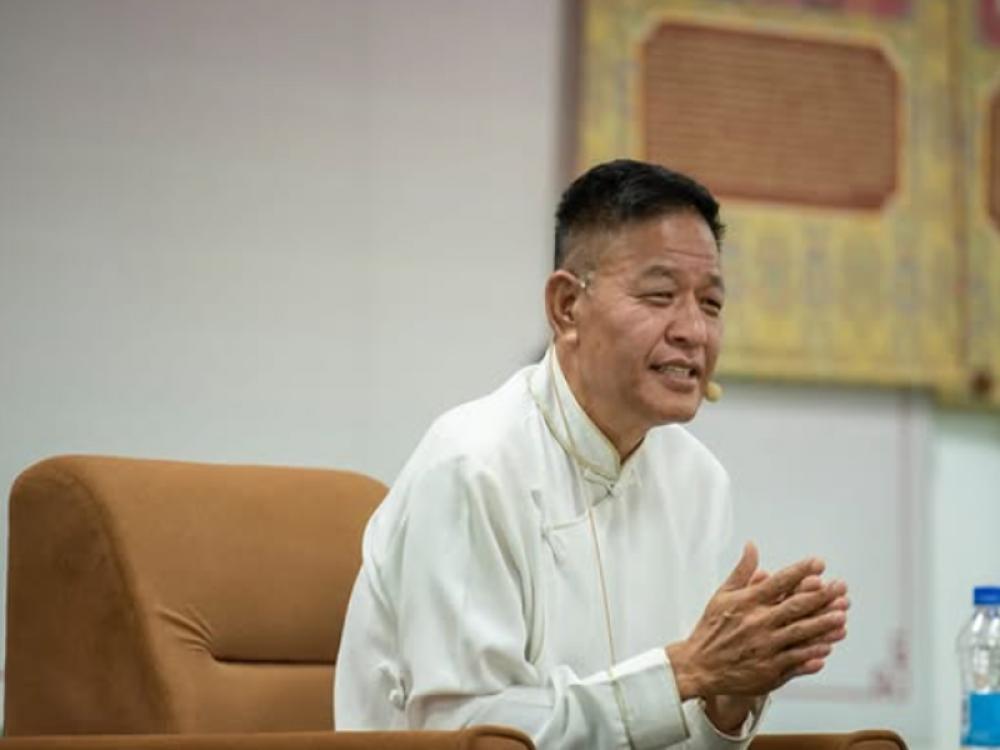
Penpa Tsering, the Sikyong (political leader) of the 16th Kashag (Cabinet) of the Central Tibetan Administration, was sworn in on Wednesday for a second consecutive term in the presence of spiritual leader Dalai Lama.
The India-based Central Tibetan Administration (CTA), headquartered in Dharamshala, is regarded as the principal institution representing Tibetan exiles.
According to the CTA website, Penpa Tsering secured 61.025 per cent of the total votes in the preliminary round of the recently concluded Tibetan general election. Under provisions of the Election Rules and Regulations, he was not required to contest the final round and was subsequently elected as the sixth directly elected Sikyong, formerly known as Kalon Tripa.
In his inaugural address, Penpa Tsering said: “The 17th Kashag reiterates our commitment to keep the thought and counsel of His Holiness the Dalai Lama at its very core. We shall uphold equitable justice founded on rules and regulations, harness collective effort through principled policy implementation, and move forward to achieve common goals.”
He added that the Kashag would continue political and social welfare initiatives aimed at ensuring the long-term sustainability of the Tibetan movement until a “just resolution” of the Tibet-China conflict is achieved.
Speaking on relations with China, he said the current policy direction of the Chinese government towards ethnic nationalities left little room for negotiations.
“Nevertheless, the 17th Kashag remains firmly committed to the ‘Middle Way Policy’ envisioned by His Holiness the Dalai Lama, which seeks a resolution to the Sino-Tibet conflict through non-violence, dialogue, and mutual benefit,” he said.
Penpa Tsering added that the administration would continue cautious backchannel communication with the Chinese government while also strengthening international recognition and support for the Middle Way Policy.
He further alleged that the Chinese government was pursuing policies aimed at erasing “Tibetan national identity”.
“At the same time, China has deliberately spread misinformation and propaganda to create division within exile communities — including the Central Tibetan Administration, Tibetan organisations, and support groups — thereby weakening the unity of the Tibetan struggle movement. It is therefore essential for all to remain vigilant against such interference,” he said.
China took control of Tibet in 1950. The 1959 Tibetan uprising began on March 10, 1959, after protests erupted in Lhasa against Chinese rule.
Armed conflict between Tibetan guerrillas and the People’s Liberation Army (PLA) had begun earlier in 1956 in the Kham and Amdo regions following the introduction of socialist reforms. The conflict later spread across Tibet and continued until 1962.
The anniversary of the uprising is commemorated annually by Tibetan exiles as “Tibetan Uprising Day”.
During the 1959 uprising, Nobel Peace Prize laureate Dalai Lama fled Tibet along with his entourage, eventually crossing into India on March 30, 1959, with assistance from the CIA’s Special Activities Division.
He has since been based in Dharamshala in the Indian state of Himachal Pradesh.