Top pick: Over 20 flights disrupted! Europe faces wave of fake bomb threats


Just Earth News | @justearthnews | 05 Nov 2026
#air pollution in India #air pollution deaths 2023 #FICCI-EY report #Clean Air Healthy India #PM2.5 pollution #air pollution health effects #India pollution crisis #Delhi air pollution
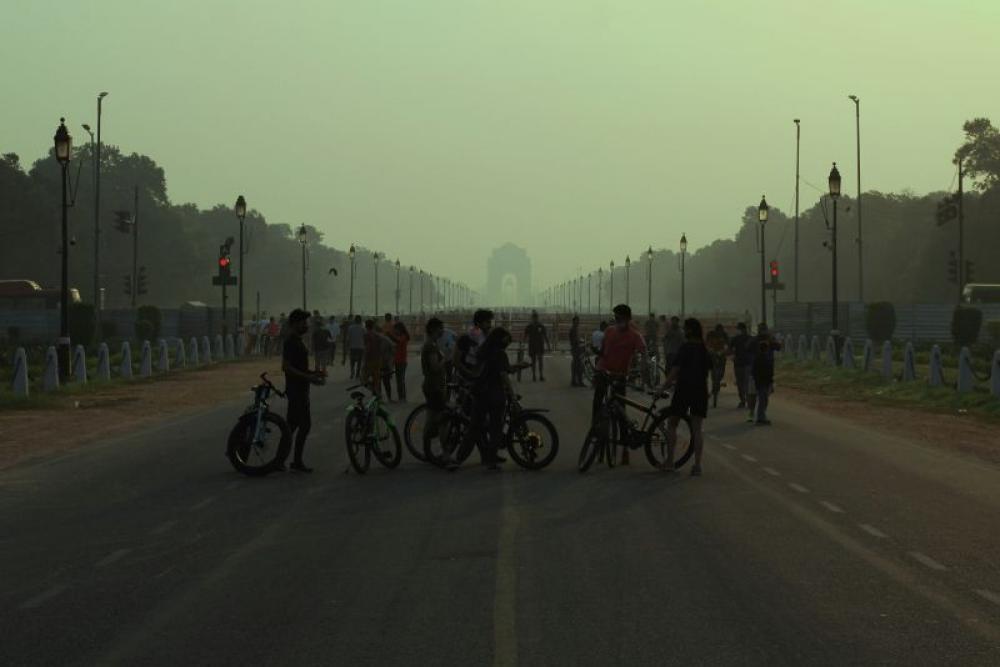
Study shows air pollution killed over 2 million Indians in 2023. Photo: Unsplash
More than two million deaths in India were attributable to air pollution in 2023, according to a knowledge paper released by the Federation of Indian Chambers of Commerce and Industry (FICCI) and EY, titled Clean Air, Healthy India.
The report highlights the severe health consequences of air pollution, particularly exposure to fine particulate matter known as PM2.5.
These tiny particles can penetrate deep into the lungs and enter the bloodstream. Prolonged exposure is associated with respiratory illnesses, heart disease, stroke and cognitive impairment, with wider implications for healthcare expenditure and productivity.
Ashutosh Raghuvanshi, Chair of the FICCI Health Services Committee and MD and CEO of Fortis Healthcare, said, “Clean air must be central to India’s healthcare agenda, not treated solely as an environmental objective. Healthcare institutions have an important role to play in strengthening public awareness, tracking pollution-related illness and improving preparedness. The FICCI-EY report calls for closer collaboration between government, industry and healthcare providers to translate clean-air commitments into measurable improvements in public health.”
Arun Agarwal, Chair of the FICCI Working Group on Air Pollution (Healthcare Perspective), former Dean of MAMC, former Additional Director General of Health Services, Government of India, and Medical Advisor to Apollo Hospitals Group, said, “We need to move beyond seasonal responses to air pollution and make exposure reduction a year-round public health priority. This requires linking air-quality monitoring with health surveillance, strengthening preventive action and tailoring interventions to local pollution sources. The FICCI-EY report provides a framework for coordinated action, with success measured not just by cleaner air, but by better health outcomes.”
Amit Goyal, Partner, Strategy and Transactions, EY India, said, “India’s clean-air agenda should link pollution control to public-health outcomes. NCAP should include explicit PM2.5 reduction targets, supported by reliable monitoring, coordinated regional action and investment in affordable cleaner alternatives. Progress should be measured by sustained reductions in people’s exposure to air pollution, rather than the number of interventions implemented.”
The FICCI-EY knowledge paper outlines 10 practical solutions to tackle air pollution, covering urban emissions, industrial pollution, waste management, financing and healthcare preparedness.
To address urban pollution, the report recommends making large construction sites closed-loop systems for dust management to reduce emissions from construction and demolition activities.
It also calls for intra-city air-quality monitoring networks to identify pollution hotspots associated with traffic, industry, construction and waste burning, while evaluating the effectiveness of different interventions.
Smart traffic signals are proposed as a way to reduce congestion and vehicle emissions caused by idling and stop-start traffic.
To tackle industrial and backup-power emissions, the report recommends introducing industrial pollution markets based on real-time stack-emissions data, retrofitting traditional brick kilns with zig-zag firing technology and replacing diesel backup systems with battery-hybrid alternatives.
It also proposes technology-driven solutions to improve the monitoring and control of industrial exhaust, diesel soot and pollution in high-exposure locations.
The recommendations include converting crop residue into fuel and marketable products to reduce stubble burning. The report also advocates using recovered plastic, industrial residue and construction and demolition waste to build houses and infrastructure.
For financing, the knowledge paper proposes grouping similar clean-air projects to enable multiple smaller but significant green initiatives to secure funding collectively.
The report emphasises the need for clear government standards and predictable regulations to support implementation. Industry, meanwhile, should focus on efficiency, competitiveness and innovation.
Healthcare institutions are encouraged to strengthen disease surveillance and public advisories, while communities should have access to reliable information and opportunities to participate in local clean-air decisions.
Ahead of the peak pollution season, the FICCI-EY paper recommends early intervention to address emission sources, supported by preparedness measures in hospitals and schools.
The report also highlights the importance of regional action, noting that Delhi’s own emissions accounted for approximately 36% of its PM2.5 pollution in winter and 26% in summer.
The report identifies several implementation challenges, including the fact that the National Clean Air Programme (NCAP) primarily measures performance through PM10 levels.
Monitoring remains uneven across smaller cities, peri-urban areas and rural regions, while enforcement capacity varies across jurisdictions.
To address these shortcomings, the paper recommends greater coordination among states and cities sharing the same air region, expanded PM2.5 monitoring, source-specific local action plans, stronger compliance tracking and outcome-linked funding.
The report stresses that sustained reductions in pollution exposure and improvements in public health should be the ultimate measures of success.