Top pick: Trump’s latest Canada shock: Lake Ontario could become ‘Lake America’


Just Earth News | @justearthnews | 27 Aug 2026
#India Nepal flood #Nepal floods 2026 #Nepal flash flood #India aid to Nepal #HADR assistance Nepal #Nepal flood rescue #Nepal flood relief #1500 missing Nepal #290 Indians missing
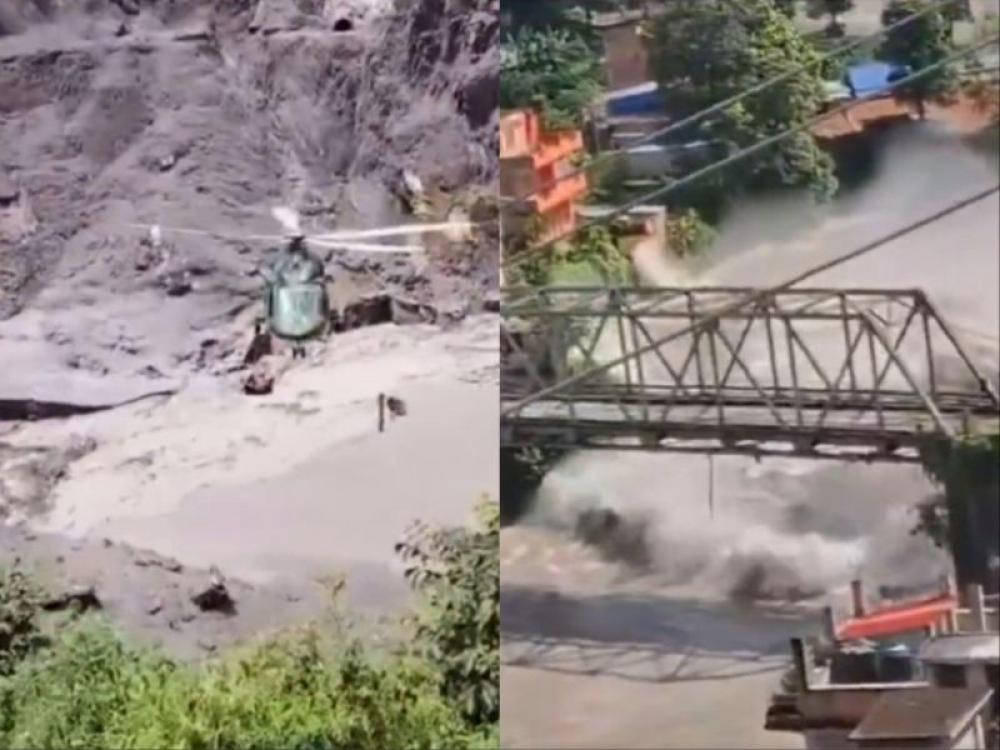
The flash flood hit the Bhotekoshi River region in Nepal around 9 am on Wednesday leaving over 400 people dead. Photo: X/videograb
India has handed over the second consignment of 37.5 tonnes of Humanitarian Assistance and Disaster Relief (HADR) material, medicines and food packets to Nepal to support its relief and rescue operations following devastating floods that have left more than 400 people dead.
At least 1,500 people remain missing after the deluge struck near the Nepal-China border, leaving the Himalayan nation grappling with one of its worst disasters in recent years.
In a post on X, Ministry of External Affairs spokesperson Randhir Jaiswal said: "A helping hand from India."
Sharing details of the latest assistance, Jaiswal said the second consignment had been handed over to Nepal's Minister for Science, Technology and Innovation, Mahabir Pun, to support the country's flood relief and rescue efforts.
A helping hand from India
— Randhir Jaiswal (@MEAIndia) August 27, 2026
The second consignment of 37.5 tonnes of HADR material, medicines and food packets has been handed over to Mr. Mahabir Pun, Minister for Science, Technology and Innovation to support Nepal’s flood relief and rescue efforts.
India remains committed to… pic.twitter.com/pYAp4YBjMX
"India remains committed to standing by Nepal and its people," he said.
Earlier, India had sent 10 tonnes of HADR assistance and essential medicines to support Nepal's relief operations.
Update on Indian nationals impacted by the floods in Nepal ⬇️ pic.twitter.com/w6ZLmSydlg
— Randhir Jaiswal (@MEAIndia) August 27, 2026
Meanwhile, External Affairs Minister S Jaishankar held a review meeting with senior Indian officials on the situation in Nepal.
"Held a review meeting with Foreign Secretary, Team MEA and our Ambassadors in Kathmandu & Beijing on the Nepal flood disaster," Jaishankar said in a post on X.
"Urgent efforts are underway to ascertain the status and well-being of all Indians in the flood-affected areas," he added.
The MEA said that at least 290 Indians remain unaccounted for following the disaster.
Nepal's security forces are continuing search-and-rescue operations despite extensive damage to roads, bridges and other critical infrastructure.
Helicopters and ground teams are being deployed to reach isolated communities and evacuate people stranded in flood-affected areas.
Rescue teams are also assessing damage to roads, bridges and other key infrastructure, while authorities continue efforts to locate those still missing.
The scale of the destruction has raised concerns over the ability of rescue teams to reach remote communities and account for the large number of people still unaccounted for.
The US State Department said it was closely monitoring the situation and deploying a disaster response adviser to the region to support relief efforts.
"The Department will also provide $500,000 in assistance through its global award with Catholic Relief Services, supporting emergency shelter, relief items, and water, sanitation, and hygiene assistance to flood-affected communities," the State Department said.
The flash flood struck the Bhotekoshi River region at around 9 am on Wednesday, August 26, causing widespread destruction across three districts.
Foreign tourists and pilgrims were among those reported missing after powerful floodwaters swept through the region.
The deluge destroyed or swept away homes, buildings, vehicles, livestock and public infrastructure, turning the disaster into one of Nepal's most devastating floods in recent years.
The latest disaster has renewed concerns over the increasing vulnerability of communities across the Himalayan region to sudden floods and other climate-related hazards.
Scientists and officials have warned that rising temperatures and changes to Himalayan glaciers and glacial systems could increase risks to communities, infrastructure and water supplies across the region.
The area witnessed a similar disaster in August 2025, when a glacial lake in Tibet overflowed amid high temperatures.
Nine people were killed in that disaster, while critical infrastructure, including a bridge linking Nepal and China, was damaged.